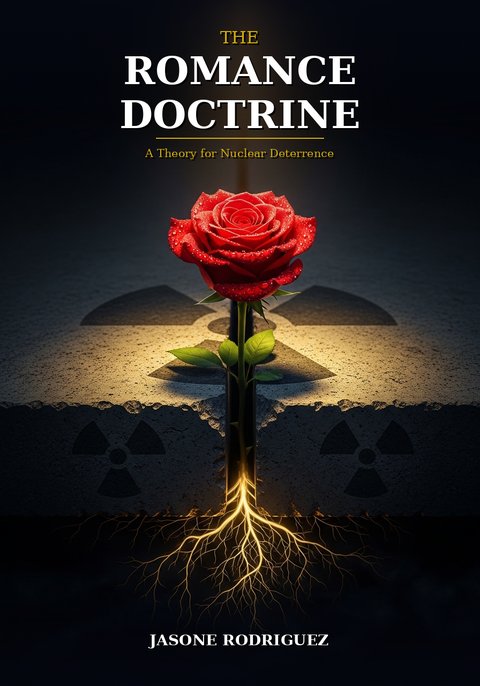
A Book by Jasone Rodriguez
The Romance Doctrine
A Theory for Nuclear Deterrence
Deterrence keeps the missiles in their silos. This book asks what could keep two nations from wanting to launch them at all.
Follow me on SubstackJasone PublicationThe ebook is available now. Paperback editions are on the way.
The Premise
The Romance Doctrine began with a song. In 1984, while the Doomsday Clock sat at three minutes to midnight, a synth recording from West Germany crossed the Iron Curtain and found an audience the Cold War said could not exist. Soviet youth heard a message of courage from an enemy nation, and they answered it with admiration.
The theory built from that observation is direct. Nuclear powers sharing maximum attack capacity can reach a deeper form of deterrence by deploying cultural products that activate the universal human need for connection, wherein the shared craving for greatness between two rivals becomes a bond that neither government can fully censor. When a given population comes to admire the culture of its adversary, the destruction of that adversary begins to feel like the destruction of something the population values in itself.
The book is not a replacement for military deterrence, it supplements it. Twelve chapters move from the underground record networks of the Soviet Union to the biochemistry of listening [oxytocin rising, cortisol falling], from the cultural operations of the CIA to the audience in Pyongyang, and on to the falsifiable predictions that the theory stakes its credibility on. More than one hundred citations across six disciplines carry the argument.
The human condition is the engine. Music is the vehicle. Deterrence is the destination.
from Chapter 1
Contents
Part I: The Sound Across Enemy Lines
- 1Forever Young
- 2The Creation of the Theory
Part II: The Cold War Dance
- 3Bones, Beatles, and the Underground
- 4The Architecture of Aspirational Symmetry
Part III: The Mechanism
- 5When the CIA Learned to Dance
- 6The Chemistry of Connection
Part IV: The Modern Stage
- 7The Audience in Pyongyang
- 8Tribalism at the Country Level
Part V: The Reckoning
- 9When the Mirror Reverses
- 10The Deliberate Courtship
Part VI: Convergence
- 11What the Theory Predicts
- 12A World Worth Saving
An Excerpt
From Chapter 1: Forever Young
The year was 1984.
The Bulletin of the Atomic Scientists had moved its Doomsday Clock to three minutes before midnight, the closest it had been since the early thermonuclear tests of 1953. President Ronald Reagan, speaking to a live radio audience in August of that year, joked that he had "signed legislation that will outlaw Russia forever" and that "bombing begins in five minutes," a remark that caused panic in Soviet military installations monitoring American broadcast frequencies. The Soviet Union, still processing the shock of the Korean Air Lines Flight 007 shootdown eleven months earlier and the false alarm at the Serpukhov-15 early warning station where Lieutenant Colonel Stanislav Petrov had, alone, prevented a retaliatory nuclear launch by trusting his instinct over his instruments, was operating in a state of perpetual defensive readiness. NATO's Able Archer 83 exercise had brought the two superpowers closer to accidental nuclear war than any event since the Cuban Missile Crisis of 1962.
Three minutes to midnight. The world held its breath.
Into this atmosphere of existential dread, a German synth pop band released a song. The band was Alphaville, a duo from Münster, West Germany. The song was "Forever Young." It was released on September 24, 1984, as a single from the album of the same name. On the surface, it was an electronic pop composition of 3 minutes and 44 seconds, with a driving synthesizer arrangement, layered vocal harmonies, and lyrics that asked a question no political scientist at the time would have recognized as theoretically relevant to nuclear deterrence.
"Who wants to live forever? I'd rather be forever young."
This was not a song about war. It was not a protest anthem. It was not an explicit political message directed at any government or military establishment. It was, on its surface, a meditation on youth, mortality, and the desire to live fully in a world that could end at any moment. The Cold War context, however, was inescapable. The song was produced at the height of nuclear anxiety. The artists performing it had grown up in divided Germany, the front line of the superpower confrontation, the place where the Iron Curtain was not a metaphor but a physical wall separating families, languages, and futures. The audience receiving it was not merely Western. This is because the same underground distribution networks that had carried Beatles records on discarded X-ray plates and smuggled Black Sabbath cassettes through closed Soviet cities were still operating in 1984, moving Western music across the adversarial divide with an efficiency that no state censor could match (Zhuk, 2010).
The song crossed the Iron Curtain. Soviet youth heard it.
On Substack
Jasone Rodriguez publishes on Substack under Jasone Publication. Subscribers receive new writing the moment it posts, including work connected to The Romance Doctrine.
Where to Buy
Available now
The Ebook, direct from this site
The complete bilingual edition, English followed by Mexican Spanish, as an EPUB file. The download starts the moment payment clears, and a copy of the link arrives by email.
Opens in Apple Books, Google Play Books, Kobo and Calibre, and on Kindle through Send to Kindle. Checkout is handled securely by Stripe; the card statement reads GLOBALVIB* ROMANCE DOC.